Spelling Words by Grade
Every grade list we use, in one place — from kindergarten sight words to competition spelling bee words. Pick a grade below, or use the picker for a random word to spell.
Tip: keep this page open on a phone and pass it around.
Spelling Words by Grade — full list (394 words)
Just want the printable version? Skip to the download ↓
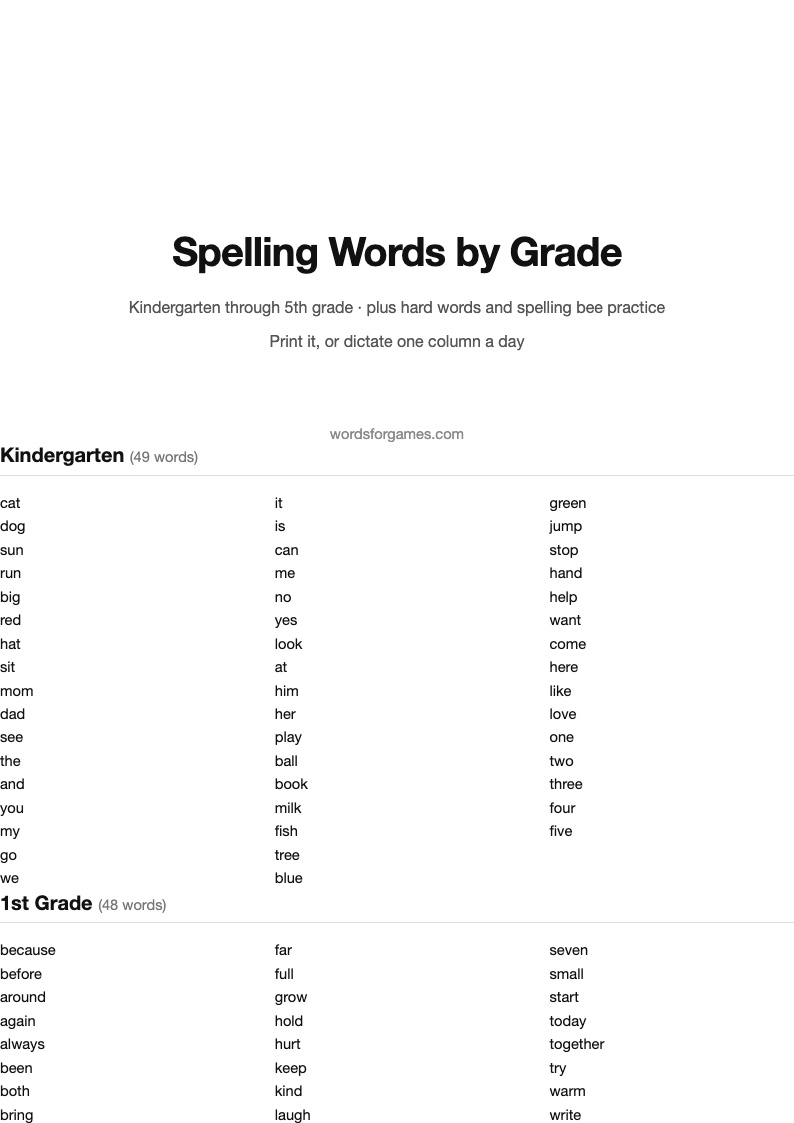
Kindergarten (49)
- cat
- dog
- sun
- run
- big
- red
- hat
- sit
- mom
- dad
- see
- the
- and
- you
- my
- go
- we
- it
- is
- can
- me
- no
- yes
- look
- at
- him
- her
- play
- ball
- book
- milk
- fish
- tree
- blue
- green
- jump
- stop
- hand
- help
- want
- come
- here
- like
- love
- one
- two
- three
- four
- five
1st Grade (48)
- because
- before
- around
- again
- always
- been
- both
- bring
- carry
- clean
- could
- done
- draw
- drink
- eight
- fall
- far
- full
- grow
- hold
- hurt
- keep
- kind
- laugh
- light
- long
- much
- myself
- never
- only
- own
- pick
- seven
- small
- start
- today
- together
- try
- warm
- write
- yellow
- your
- zoo
- about
- after
- any
- as
- ask
2nd Grade (49)
- above
- almost
- along
- began
- being
- below
- better
- between
- certain
- city
- close
- cold
- country
- course
- decide
- different
- during
- early
- earth
- enough
- even
- every
- example
- family
- father
- finally
- follow
- found
- friend
- group
- heard
- high
- himself
- important
- inside
- knew
- large
- learn
- leave
- life
- might
- moment
- mountain
- music
- night
- number
- often
- order
- paper
3rd Grade (50)
- afternoon
- against
- already
- although
- answer
- beautiful
- beginning
- believe
- birthday
- calendar
- carefully
- caught
- chocolate
- climb
- clothes
- complete
- continue
- dinner
- doctor
- dollar
- evening
- everyone
- everything
- famous
- favorite
- finished
- guess
- happened
- interesting
- kitchen
- language
- lesson
- library
- listen
- machine
- minute
- morning
- museum
- nurse
- ocean
- people
- picture
- popular
- probably
- question
- quiet
- really
- remember
- restaurant
- science
4th Grade (50)
- accomplish
- achievement
- address
- advantage
- advertisement
- ambition
- appreciate
- argument
- association
- athlete
- audience
- autumn
- benefit
- boundary
- brilliant
- business
- campaign
- category
- challenge
- character
- community
- company
- competition
- concentrate
- conclusion
- confidence
- conversation
- courageous
- curiosity
- decision
- definitely
- delicious
- department
- describe
- develop
- dictionary
- difference
- difficult
- disappoint
- discipline
- discover
- discussion
- distance
- education
- elevator
- emergency
- employee
- encourage
- energy
- engineer
5th Grade (50)
- accommodate
- acknowledge
- acquaintance
- acquire
- aggressive
- apparent
- appearance
- assassination
- basically
- changeable
- colleague
- committed
- congratulate
- conscience
- conscientious
- controversy
- desperate
- dilemma
- disastrous
- embarrass
- environment
- exaggerate
- excellence
- existence
- experience
- foreign
- forty
- fulfill
- gauge
- genius
- government
- grammar
- guarantee
- harassment
- height
- hierarchy
- humorous
- ignorance
- immediate
- independent
- indispensable
- intelligence
- jewelry
- judgment
- knowledge
- liaison
- license
- lightning
- maintenance
- maneuver
Hard Words (48)
- medieval
- millennium
- miniature
- mischievous
- misspell
- noticeable
- occasion
- occurrence
- parallel
- parliament
- pastime
- perseverance
- personnel
- possess
- precede
- preferred
- privilege
- pronunciation
- publicly
- questionnaire
- receipt
- receive
- recommend
- referred
- relevant
- rhyme
- rhythm
- ridiculous
- sacrilegious
- schedule
- separate
- sergeant
- sincerely
- successor
- surprise
- temperature
- threshold
- tongue
- truly
- twelfth
- unnecessary
- vacuum
- vehicle
- weird
- wherever
- whether
- bureaucracy
- camouflage
Spelling Bee (50)
- abattoir
- aberration
- abhorrence
- abstemious
- accede
- acolyte
- adjudicate
- aficionado
- alacrity
- allegory
- anachronism
- ancillary
- animosity
- antediluvian
- apocryphal
- archipelago
- assiduous
- astringent
- audacious
- auxiliary
- avarice
- bellicose
- benevolent
- cacophony
- camaraderie
- capitulate
- capricious
- celerity
- chagrin
- chicanery
- clandestine
- cognizant
- colloquial
- compunction
- conflagration
- connoisseur
- contiguous
- corollary
- crescendo
- cryptic
- deleterious
- demagogue
- desiccate
- diaphanous
- dichotomy
- didactic
- disingenuous
- ebullient
- egregious
- elucidate
Get the K-5 spelling pack
Every grade list from kindergarten to 5th grade, plus hard words and spelling bee practice, in one printable PDF.
No spam. One or two emails a month, unsubscribe anytime.
Download your printable pack →What changes from kindergarten to 5th grade
The lists on this page are not ordered by difficulty for its own sake — each grade introduces a new spelling rule, and the words only make sense once that rule has been taught. Knowing what changes when is what stops you handing a 2nd grader a list built for 5th grade.
Here is the progression we build the grade lists around.
- Kindergarten: short vowel CVC words (cat, sun, bed) plus a handful of sight words. Everything is sounded out letter by letter.
- 1st grade: blends and digraphs (sh, ch, th), simple plurals, and the first words that break the rules (said, was).
- 2nd grade: silent e, vowel teams (rain, seed), and the -ing ending. Word length stops predicting difficulty here.
- 3rd grade: prefixes and suffixes, doubled consonants before -ing, and the first homophone pairs (there/their, to/too).
- 4th grade: Latin roots, -tion/-sion endings, and words where the unstressed vowel is a schwa (separate, definitely).
- 5th grade: borrowed spellings from French and Greek (chaos, rhythm), silent letters, and the words that show up in spelling bees.
Spelling words for adults
A surprising number of people arrive here looking for spelling practice as an adult — for a citizenship test, an English exam, or simply because they were never taught the rules. The grade lists are the right place to start, but not at the grade that matches your age.
Work backwards instead: find the first grade where you can spell every word comfortably, then begin one grade after it. Adults usually clear K-2 in an afternoon, and the useful work starts at 3rd grade.
- Start with the pattern lists rather than the grade lists: silent letters, doubled consonants, and -able versus -ible cover most adult misspellings.
- Keep a personal list of the ten words you actually get wrong in emails. That list beats any published list, because it is measured on you.
- Say the word in syllables as you write it (ne-ces-sa-ry) instead of relying on how it sounds — English spelling stopped matching pronunciation centuries ago.
- If you only practise one thing, practise the schwa: the lazy vowel in the middle of separate, definite, business and February is where most adult errors live.
Everyday words people ask us how to spell
The most common spelling questions we see are not about hard words at all — they are about the ordinary words people need in a form or a text message: recycling, garbage, waste, timer, clock. These are easy words with an unusual letter in them, so here are the hooks that actually stick.
- recycling — re + cycle + ing. If you can spell "cycle", you can spell it. It keeps the y.
- garbage — two a's and one e, in that order: garb-age. The ending is the same -age as "package".
- waste — the silent e is doing the work: it makes the a long, as in "waste of time". Without it you get "wast".
- timer — time + r. Keep the e from "time"; it is not "timr" or "timber".
- clock — double c, and no k. The k sound at the end is already spelled by "ck".
- cuckoo clock — the bird is the odd one: cuckoo has two u's and two o's, then "clock" is ordinary. It is the same bird as in "cuckoo" the sound.
- disposal — dispose + al. Drop the e before the -al ending, exactly like "propose" → "proposal".
- trash — one syllable, one a, and the sh digraph at the end. No final e.
How to play
- Start with 5-8 words a week for younger children and 10-20 by 3rd grade. Short daily practice beats one long session.
- Say the word, use it in a sentence, then let the child write it. Retest only the ones they missed.
- Group words by spelling pattern (silent e, double letters, -ight) instead of alphabetically — one rule is easier than 20 unrelated words.
- Keep a running list of their personal misspellings. Five of their own words beat twenty from a worksheet.
FAQ
How many spelling words should a child learn per week?
Kindergarten and 1st grade: 5-8 words. 2nd grade: about 10. 3rd to 5th grade: 15-20. Accuracy matters more than volume.
What are the hardest spelling words?
Words with silent letters, double consonants and borrowed spellings: rhythm, conscience, maintenance, bureaucracy, camouflage.
Should spelling words be alphabetical?
No. Grouping by pattern (silent e, -ough, double letters) teaches the underlying rule instead of memorising 20 unrelated words.
How do I test spelling at home?
Read the word, use it in a sentence, then let the child write it. Mark it together and practise only the missed words the next day.
What spelling words should a 5th grader know?
Borrowed spellings from French and Greek (chaos, rhythm, guarantee), silent letters, and the -tion/-sion family. Our 5th grade list is built from exactly those groups rather than a random selection.
Where can adults find spelling words to practise?
Use the grade lists, but start one grade above the first one you can spell perfectly — most adults clear kindergarten to 2nd grade in an afternoon and the useful work starts at 3rd grade. Patterns (silent letters, doubled consonants, -able versus -ible) cover most adult errors.
How do you spell recycling?
R-E-C-Y-C-L-I-N-G: re + cycle + ing, keeping the y from "cycle". The same pattern covers recyclable and recycled. Our everyday-words section covers the other common lookups (garbage, waste, timer, clock) with a memory hook for each.